Showing posts with label Millet. Show all posts

Friday, November 27, 2009

The Latest

Thank you to everyone who's written to make sure I'm okay- I am okay, really. I will be in Niger for one more week before flying to Morocco and, eventually, to Oregon. It's an earlier take-off than I'd had in mind, but given everything that's gone on here recently it is an acceptable compromise. I'll take two weeks in Morocco, why not?

And, because I promised to include more information about "the situation", here goes. To the best of my knowledge: two weeks ago there was an attempted kidnapping of Americans in Tahoua, which is the capital of my region and a few hours north of my home. There have been a series of attempted and/or successful kidnappings of Europeans in and around Niger/Mali over the last year; most (if not all) of these are presumed to be the acts of an Al Quaeda group based in Mali. Because of the proximity and boldness of the Tahoua attempt, and because it appeared to target Americans, Peace Corps withdrew immediately from the region.
And that's why I had to leave my village early. I've spent the last two weeks trying to be useful (or, alternately, sitting in an absolute daze) in Konni, Niamey, and the training site at Hamdallaye, and will tackle my end-of-service paperwork next week before embarking on my last-minute trip to Morocco.

I have managed to talk with my family and friends in my village every day; we all appear to be (mostly) over the huge bummer of my sudden departure and are just happy to be able to hear each other's voices. They're wrapping up the harvest and preparing for the biggest holiday of the year-- Tabaski, which will happen tomorrow. Obviously I won't be able to partake in the festivities with them this time, but I will celebrate here in Niamey with city-Nigerien friends. What will we do? Be thankful for each other, dress up, visit and greet many people, slaughter a sheep, and eat lots and lots of meat for two days. Barka da Salla!

Below are a few pictures from my last days in the village.


Above are Rahido, Alkasum, Idi, and Wan Mano filling a granary with newly-harvested bundles of millet. The average family will eat approximately one bundle's worth of millet a day. This year, in our area, a family is lucky to get 150 bundles out of their fields. After the bundles run out, they will rely on money sent home from sons and husbands on work exodus to purchase bags of millet from the market.


Two days before I left, a truck pulled up at 7:30 in the morning with our twenty-five gorgeous new school desks!! That was so exciting. In this picture you can see Chaibou, the school director, and Isseuf, the man who arranged the construction and delivery of the desks.


Here is the inside of the new classroom, with new desks in place. In this picture are Narba, Balkissa, Rabi, Malim, Chaibou, and Isseuf. Balkissa, Rabi, and Malim are teachers for the youngest students; Chaibou will teach the two oldest grades in this new building.
There are so many more pictures that I wanted to take before leaving. I guess those will have to wait.


Tuesday, January 6, 2009

What we eat and how it's made


In the couple of weeks that I've been home for Christmas, I've gotten a lot of questions about what I eat in Niger, and about what everybody else eats, on a normal day. The curiosity is mutual! People in my village are also keen to know what it is that we eat in the States, and I am asked about it all of the time. They guess that Americans eat a ton of meat, bread, and rice- a pretty accurate guess if you ask me! I'll try to shed some more light on the typical diet for rural Nigeriens, and also on mine.

So, first: as alluded to in previous letters, Nigeriens eat millet, every day. In my area, it is usually the only thing eaten. It comes in two main forms: as hura or as tuwo. Hura is a millet+milk=water porridge that is drunken from midmorning until night- basically, whenever you're hungry or thirsty, you take a few gulps of hura. Tuwo is a thicker millet meal that is hardier and more solid than hura; it's served with sauce made from any available ingredients (usually dried okra, dried tomato, garlic, and salt, plus any dried leaves gathered in the fields). Tuwo isn't made every day; it takes longer to prepare than hura.

The making of either
hura and tuwo for a family of 10 people takes anywhere between 3 and 4 hours when the labor is shared by two or three women. A really long time. In the example of hura, you have to: 1. Carry a bundle of millet stalks from your granary to the threshing area (threshing areas are communal spaces, usually on the edge of the village, where women work together with women from other families). (10-20 minutes) 2. Beat the stalks with a stick to separate the millet from the stalks. (20-30 mins) 3. Beat the millet chaff off of the seed using a large pounder or a long stick. (20-30 mins) 4. Separate the chaff from the seed by using the wind to blow away the chaff. (20-30 mins) 5. Take the seed from the threshing area to your home. (10-15 mins) 6. Pound the seed to remove the husk. (20-30 mins) 7. Wash the husk away in water, which is then given to the animals to drink. (15-20 mins) 8. Pound the husk-less seed (the germoplasm) into a course flour. (15-20 mins) 9. Roll the coarse flour into large balls and boil them to soften them up. (15-20 mins) 10. Pound the boiled flour balls with a little bit of water until they make a solid lump of dough. (10-15 min) 11. Mash the dough in a bowl of cow's milk, add water and hot pepper, and voila! It's ready.

The sound of millet being pounded is a constant one; I can hear it before the sun comes up every morning. I'm sure you wonder what it actually looks like, so here's some video of Zuera and Mariama .


Thursday, November 13, 2008

Millet harvest

Millet that I planted in my concession
9/2/08
I'm trying to remember what the last season was that I described to you; I think it must've been when things started to turn lush green. Oh, and then I wrote about the dry spell when things turned yellow. Let me catch you up. The hasi (millet) is now several feet over my head, and it has started to lean and bend in tall green curves from the weight of its seeds. In most fields, the millet heads are filled out and still slightly green, though some are dried out and ready to harvest. Last week people started to harvest some of the green heads; they can be grilled over coals and eaten like that, or set out to dry in the sun and then pounded as usual. To help you imagine, millet plants resemble corn plants, and the heads are a similar shape and size, but they aren't covered by husks. The seeds are much smaller, and round (just take a peek at your birdseed mix). The heads are harvested ki
nd of the same way as corn--well, not exactly--you cut the stalk close to the base of the seed head. It is the hungriest families who harvest the green millet; they do so because their personal stores have run out.

Harvesting my own millet:
The knife was a piece of scrap metal; Narba finally just took it from me, and I was glad.


Thursday, October 2, 2008

Millet, moringa, neem, baobab, veggie starts

Baobab seedling
8/7/08
For several weeks now--months, even--I've been prepping areas around my hut for gardens. It's really gratifying to see what was just solid, heat-baked clay and sand be transformed into something that more closely resembles soil! After chopping at the slate-like plots with every tool available (village-made hoe/ax and big sticks), I mixed in manure that my neighbors gave me. They watched with great amusement as I shoveled their goats', cows', sheep's, and donkeys' poop into my big "I Love Africa" bucket. Since then I have been adding water and millet chaff. And now: I have four garden beds! With plantable soil! Well wait, "plantable soil" does not make sense , but you get it, right? And in the meantime, the tomatoes, peppers, eggplants, and collards that I seeded are close to ready for planting.

I should clarify what I wrote about my neighbors: while at first they were just amused about my garden project, they quickly saw I was earnest about it and helped me collect and carry everything home! Ibrahim asks about it every day, and my women neighbors Lahadi, Abu, and A'i are ever-curious. This morning I was hacking away at a new bed when Karima, an influential village lady who sells odds and ends and goro (kola nut) from her home, and Aoma'u came by with Narba. Narba was so funny. She led them all around my concession, showing off all of the work I've done: my two meager rows of millet (now almost as tall as me!), the moringa, neem, and baobab trees, the beds I've dug, and the little veggie starts. I was dripping with sweat and covered in sand and goat poop, and even goat fur, but I stood there proudly as Narba clucked away.


Mature baobab tree
Photo by Brett


Monday, May 12, 2008

Pounding millet


NYT photo


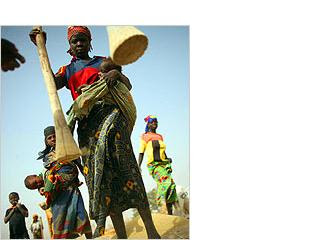
In the morning, women are really busy pounding millet or other grains to cook for the day. "Pounding millet" is a really literal term that could also be described as "using every muscle in one's body to lift a really heavy pounding stick straight up and beat the heck out of grains in a wooden bowl-thing, the end result being women with callouses the size of mushrooms, and men with full bellies."
People ask me all the time if I am able to pound millet, and the answer is "kind of."
I try to help my neighbors and take a turn at it, but the reality is that I suck at it and I always end up getting blisters and really sore shoulders. So, by the end of two years I should be wickedly strong. You can pretty much hear the sound of millet being pounded (thump! thump!) all day long, and into the evening.